Deslinde Is About the Land. Your Apartment Comes From a Different Survey.
Look up deslinde while shopping for a condo in Punta Cana and nearly everything you read is about ground: surveyors, boundary markers, a court. Almost none of it explains the step that turns one titled lot into a set of separately owned homes, which the registry calls división para constitución de condominio. For a building still going up, such as Moon Garden 2 with its 108 residences inside Coral Golf Resort at Cabeza de Toro and delivery scheduled for 2027, that second survey is the one worth understanding. This page follows the chain from land to unit, reads the registry's own requirements list for the condominium survey, and ends with the documents a buyer or their attorney can obtain directly.
What deslinde fixes, and what it leaves alone
Deslinde belongs to the land side of the Dominican registry. The Registro Inmobiliario describes it as a contradictory process that locates, determines and individualises rights held under constancias anotadas, documents that record how much ground someone owns inside a larger parcel without ever saying where that ground is. What comes out the other end is a parcel with borders and a certificado de título of its own.
That was a common problem, which is why Article 129 of Ley 108-05 stopped the registry issuing new constancias anotadas once the law came into force in 2005, with an exception for property already placed under a condominium regime. Older constancias still circulate, and clearing them is the job of deslinde or, since the Supreme Court's October 2025 resolution, more often of the administrative route called regularización parcelaria.
Notice what none of this does. A deslinde never divides a building into homes. It stops at the parcel. Everything between "a titled lot with a building on it" and "an owner's name on the certificate for one apartment" is handled by other registry acts, and those are the ones a condominium buyer actually depends on.
The survey that turns a lot into apartments
The registry's name for it is división para constitución de condominio, and its service sheet states the purpose plainly: the condominium regime is used to divide buildings, residential and hotel complexes and similar developments wherever an inseparable link is meant to exist between areas owned exclusively and areas owned in common. An apartment is the exclusive part. The lobby, the pools, the corridors and the land underneath are the common part, and this survey is what draws the line between the two.
Two details on that sheet carry more weight than they first seem to. The work is done by a licensed professional authorised by the regional Dirección de Mensuras Catastrales, at the request of a person or company whose rights are backed by a certificado de título, so a constancia anotada cannot open this door. And the registry charges its service fee per functional unit, RD$1,000 for each apartment the division creates, rather than per building. That is the registry's tariff alone, not the surveyor's or the lawyer's fee, but it shows plainly that the unit, not the tower, is the thing being registered.
Applied to a building like Moon Garden 2, the division is the step at which each of its 108 residences would become a separately described unit, with the common areas defined around them.
Reading the condominium survey file
The Registro Inmobiliario publishes the list of what a division file must contain. It is a list of documents rather than a sequence of steps, and several items on it answer questions that a buyer of an unfinished building would otherwise have to take on trust.
The surveyor's declaration is the line to read twice. The registry expressly contemplates a condominium that is finalizado o en proceso de construcción, finished or still being built, which is how a building due to deliver in 2027 can have its division surveyed before the last wall goes up. The registry also publishes a matching title-side service for registering a regime in process. That describes a route that exists; it says nothing about where any particular project currently stands on it.
| Item on the registry's list | What it tells a buyer |
|---|---|
| Construction licence, or the approving document from the competent authority | The building has been authorised. The division cannot be filed without it. |
| The set of construction plans approved by the authorities | The unit being surveyed is the one that was permitted, not a sales drawing. |
| A georeferenced plan verifying the parcel's current state | The lot is checked against the register before anything on it is divided. |
| Plans of the division, and the condominium's sheet of schedules | Where each unit and each common area sits, drawn and tabulated. |
| The surveyor's declaration | Confirms the state of the parcel, checks the area of every functional unit and the other spaces, and says whether the building is finished or under construction. |
| Acta declaratoria de condominio | The owner's formal declaration placing the property under the regime. |
| A coordinate file of the parcel with the condominium's sectors | Each unit is tied to coordinates, so it can be located rather than merely described. |
| Certificación del estado jurídico and the title duplicate | The land's current position in the register is on file from the start. |
From resort land to a titled apartment, in order
Put the pieces together and the chain behind a unit in a master-planned community runs roughly as follows. Each link is its own registry act with its own paperwork, and each can be asked about by name.
-
The land enters the register Unregistered ground comes in through saneamiento, which Article 20 of Ley 108-05 treats as first registration. Registered ground held under constancias anotadas is individualised by deslinde or by regularización parcelaria.
-
A lot is created for the building The registry lists subdivisión, which creates new parcels by dividing a registered one, and urbanización parcelaria, which does the same while opening streets that give the new parcels access to public services. Which act, if either, produced the lot under a given building is something its file answers, not something to assume.
-
The building is divided into units The división para constitución de condominio is surveyed and lodged with the regional survey directorate, which reviews the technical work before anything reaches the title registry.
-
The regime is registered At the Registro de Títulos the file brings together the acta declaratoria, the condominium's own reglamento, the approved division plan, the title duplicate, a certification from the authority that approved the building plans and a current IPI certificate from DGII showing the property up to date or exempt. Where the land carries a mortgage, the list adds a contract substituting that guarantee and a certification from the creditor.
-
Each unit receives its own certificate Under Article 101 the condominium exists once it is registered, and each exclusive unit is then entered with a certificado de título of its own. That is the document that carries an owner's name.
Two things you can look up without anyone's permission
The first is the certificación del estado jurídico del inmueble. The registry issues it to any interested person; its current service sheet asks the applicant to identify a legitimate interest, and a foreign applicant files with a passport plus a second national ID. It can be requested at any Registro de Títulos by remote deposit, through the registry's Oficina Virtual or on its RIMóvil app, and the registry's service fee is RD$1,000 per property. It confirms whether the title duplicate is still valid and lists the entries standing in the property's complementary registry on the day it is issued. A certificado de título is different: it is a print of the register as it stood when it was made, and it cannot show anything recorded afterwards.
The second is the registry's public Consulta parcelario catastral, a map service that shows approved, historical and annulled parcels over satellite imagery. It is a map, not a title search, but it lets you see whether the ground a brochure describes corresponds to an approved parcel, and it gives an attorney the parcel designation to request everything else against.
Neither replaces a Dominican attorney of your own choosing. Both make the conversation with one far more specific.
Questions to put in writing before 2027
For a pre-construction purchase the useful questions are about sequence: which of the acts above have already happened for the land under the building, and which still lie ahead. Ask them in writing, and ask for the documents rather than a description of them.
- What is the parcel designation under the building, and is that parcel held under a certificado de título?
- Does a recent estado jurídico show any mortgage or annotation on the parcel, and how will a lender's guarantee be dealt with when the regime is registered?
- Has the división para constitución de condominio been lodged, and has the regional survey directorate approved it?
- Is the condominium regime registered, or registered as a regime in process, and on what date?
- In the approved division plans, what area is given for the specific unit you are buying, once converted to square feet?
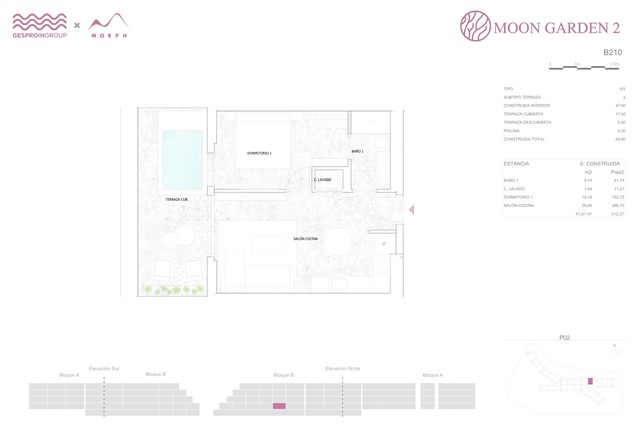
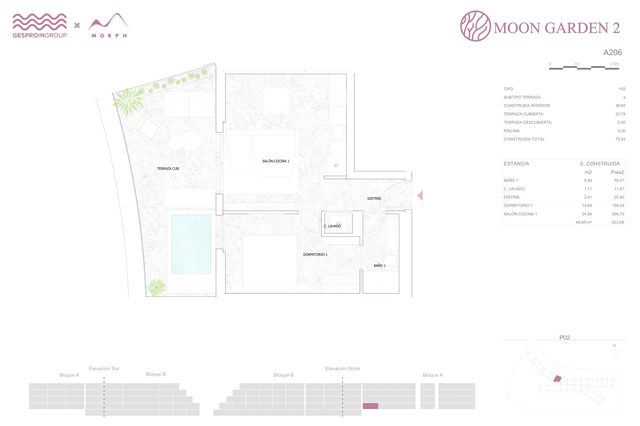
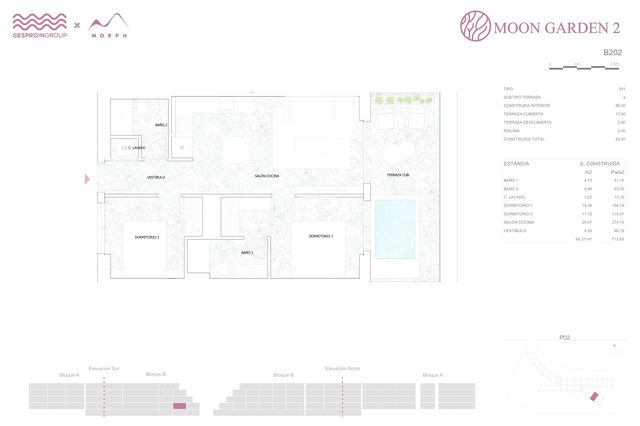
That last question is not pedantry. Moon Garden 2's published floor plans start at 695 sq ft, and the area the registry works from is the surveyor's checked figure in the division file, not the sales sheet. If the plans state areas in metric units, convert them before you compare.
Common questions
- If a building is sold off-plan, has anything been surveyed yet?
- The land, yes; the units, not necessarily. The registry's condominium division can only be requested by someone whose rights rest on a certificado de título, and it needs the construction licence and the approved plans, but it may be carried out while the building is still under construction, and the surveyor's declaration says which. Whether it has been done for a particular building is answered by that building's file, so ask to see it.
- Can I ask the registry about a property I have not bought yet?
- Yes. The certificación del estado jurídico del inmueble is issued to any interested person, who states their legitimate interest in the request. A foreign applicant uses a passport plus a second national ID, the request can go through the Oficina Virtual or the RIMóvil app, and the registry's fee is RD$1,000 per property.
- Is a subdivision the same thing as a deslinde?
- No. A subdivision starts from a registered parcel that is already located and splits it into new parcels. A deslinde starts from a right that has an area but no location, recorded in a constancia anotada, and gives it one. The first divides something known; the second finds something that was never placed on the ground.
- Why would a mortgage on the land matter to someone buying an apartment?
- Because a loan secured on the whole parcel sits underneath every unit on it. The registry's list for registering a condominium regime includes, where it applies, a contract substituting the mortgage guarantee and a certification from the creditor, which is where it expects a lender's security over the land to be addressed. Ask how that will be handled for the building you are buying into.
- Will my unit's registered area match the brochure exactly?
- Do not assume it will. The division file contains the surveyor's check of each functional unit's area, and that surveyed figure is what the registry works with. Moon Garden 2's published floor plans start at 695 sq ft; ask your attorney to compare the figure for your unit in the approved division plans, converted to square feet, with the plan you were sold.
Want the details for your own situation?
Ask about availability, layouts or the buying process, and someone from the sales team will get back to you.
Get in touch